Frequently asked questions
The Middle Arm Precinct is set to emerge as a globally competitive, industrial precinct, and will help to rebuild the economy.
The NT Government is planning a precinct where industry can come and confidently do business. A precinct that aligns with environmental regulations, giving community confidence in the activities taking place.
We have used what we have learned in our conversations with the community and stakeholders to answer frequently asked questions about the Middle Arm Precinct.
Location of the Precinct
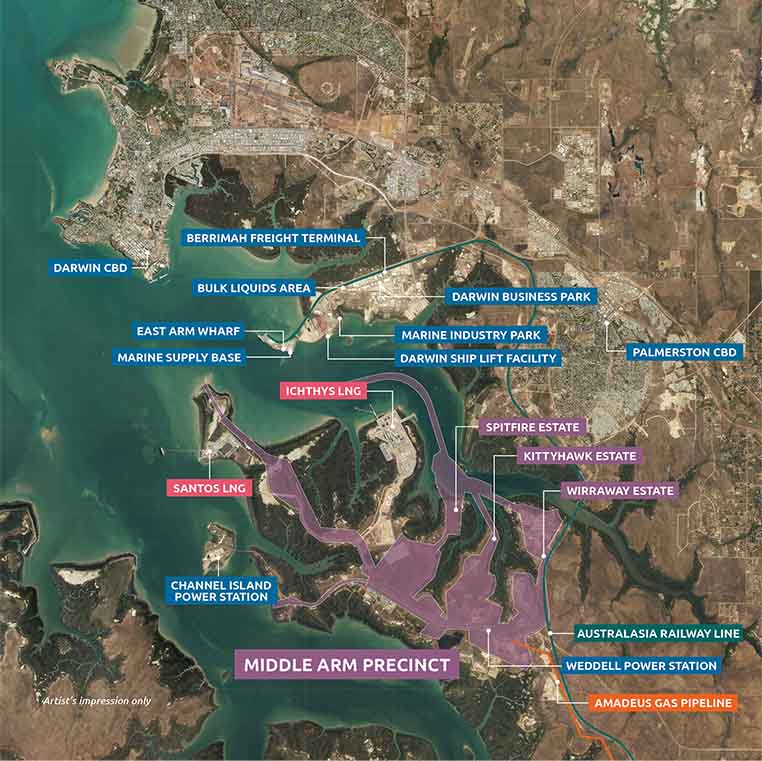
Middle Arm is in Darwin Harbour across the Elizabeth River from Palmerston and opposite East Arm Port.
It is 13km south of Darwin’s CBD as the crow flies, or about 40km by road. It is already home to the Channel Island power station (that supplies power to Darwin and Katherine regions) and the Weddell power station.
INPEX’s Bladin Point LNG plant and Santos’ Darwin LNG plant both currently process natural gas into liquefied natural gas at Middle Arm – both companies are committed to net zero emissions including planned carbon capture and storage projects.
Middle Arm’s position reflects the importance of Darwin in relation to our neighbours in the north, and the whole of the NT's opportunity to build on our competitive strengths and to support long-term economic security.
Working together with an integrated and coordinated approach across the Territory, as well as a focus on enhancing links with Asian markets, will capture synergies and maximise value for money.
-
This project aims to transform Middle Arm into a precinct where proponents could develop industrial facilities.
Similar to a sub-division, the precinct will develop land at Middle Arm and common user (shared) infrastructure to service large industrial blocks. The Precinct would then be ready for industry to develop their facilities on the site.
The proposed precinct area covers about 1,500 hectares or 15 square kilometres. The newly developed land would have dedicated areas for specific industries and common user infrastructure such as:
- new roads
- power and water supply
- telecommunications
- infrastructure corridors
- module offloading facility
- a shipping channel.
Proponents will also be developing jetties as part of their projects.
Read more about the precinct.
-
The project is currently in the planning and design stage, attracting industries focussed on renewable energy, low emission liquefied natural gas, carbon capture utilisation and storage, minerals processing and hydrogen.
The infrastructure is being master planned to be shared by the facilities which will operate in the precinct. By doing this, we can eliminate wasteful spending, minismise impacts and avoid unnecessary duplication.
This includes a shared shipping channel, module offloading facility, and a common use facility for industries in the Precinct to share.
Master planning is also considering road upgrades, a renewable energy network, service and product corridors, water systems and a carbon capture, utilisation, and storage hub.
The proposed precinct area covers about 1,500 hectares or 15 square kilometres. Industrial land is available for future development.
To date, the NT Government has issued 'not to deal' commitments with proponents over specific land at the precinct.
Read more about the industry types.
Carbon Capture, utilisation and storage
Carbon Capture and Storage is an important technological option for reducing CO2 emissions and is essential to decarbonisation.
The precinct master planning includes a world-class carbon capture and storage hub to trap at least 90 per cent of emissions.
Carbon removal is required to balance emissions across the energy system. This innovative process captures carbon emissions, either storing them deep underground in geological formations or reprocessing them into valuable products like urea which is used mainly for fertiliser in agriculture.
More than 390 Carbon Capture and Storage facilities are under construction or in operation worldwide. 12 of the operating facilities are in the Asia-Pacific region.
Carbon Capture and Storage plays a significant role in decarbonising industries like cement manufacturing and in the power sector.
-
Regulation is about making sure any project is the right thing for everyone; communities, economy, environment and for future generations. The Precinct is being assessed as a strategic proposal under both Territory and Federal legislation.
The strategic environmental assessment sets the framework for development. The comprehensive process will deliver certainty for both business and community, outlining the types of development activity approved to occur, and the conditions under which they may operate. It is a rigorous assessment that
considers the regional and cumulative impacts of a program of multiple projects over decades.Approval of the program at the level of strategic assessment does not provide approval for individual proponent activities. Individual proponents will still have to complete an approval notice application process on top of demonstrating they comply with the program. This process will include community
and stakeholder consultation.Read more about the strategic environmental assessment.
-
The precinct will be developed gradually over many years.
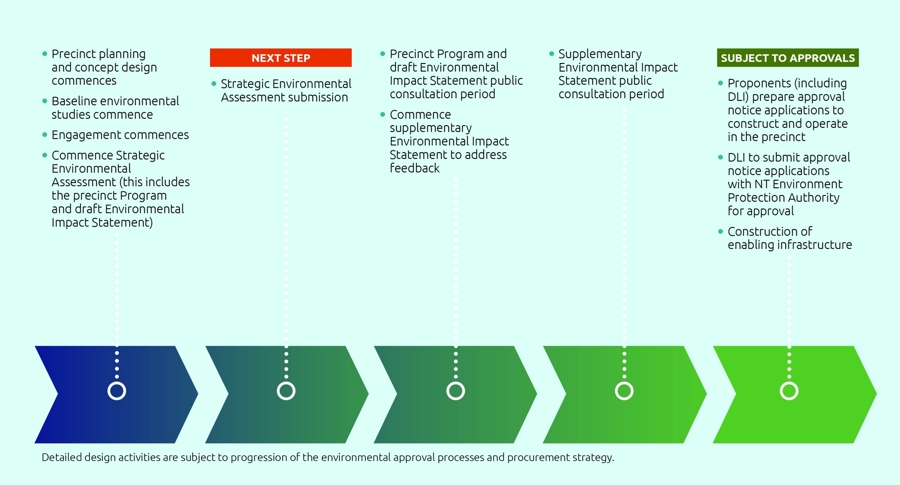
The strategic environmental assessment is in progress and covers development over a 50-year period from the date of approval.
The NT Government plans to commence construction of enabling infrastructure, after gaining all necessary approvals.
The timeline for the construction and operation of common use infrastructure, and individual industrial facilities within the precinct will be proponent driven, and subject to the strategic approval and project-specific approval notices.
Currently, the Department of Logistics and Infrastructure is preparing the draft Environmental Impact Statement (EIS) and Program. These will be published for public comment and feedback.
The Department will then complete a supplementary EIS, and this will be published for comment and feedback.
Interested industries (proponents) who want to locate themselves in the Precinct, will develop and submit their approval notice application to the NT EPA. Approval notice applications will be published for public comment and feedback.
-
The Middle Arm Precinct will not negatively impact the health of the NT population.
A Human Health Impact Assessment (HHIA) is being conducted for the precinct as part of the strategic assessment process.
The HHIA studies the potential impacts on human health associated with air quality, the effects of dust, noise and vibration, risks from biting insects, and navigation and safety risks.
The HHIA findings will be discussed in the published draft EIS. The draft EIS will present an assessment of the potential human health impacts associated with the precinct development, and address how those impacts will be avoided or mitigated to a level that is in accordance with Australian Standards and Guidelines.
The information in the chapter will be presented for the purpose of allowing the community and stakeholders to comment and provide feedback, and to enable the NT EPA to evaluate whether the controls that are proposed will allow the objective for human health to be met.
Commitments associated with further studies, monitoring and management will be identified in the chapter.
Project proponents will also be required to undertake a HHIA in accordance with the most current health guidelines and National Environment Protection Measures (NEPM) for air quality. The assessment will be required to demonstrate that project specific and cumulative health risks meet acceptability criteria in accordance with the most current health guidelines. The results of this assessment will be presented with an approval notice application.
-
136 environmental studies such as:
- air quality assessment
- water quality assessment
- marine ecology study
- human health impact assessment
- noise, traffic and visual amenity studies
- flora and fauna conservation strategy
- social impact assessment
- archaeological study
- economic impact assessment.
235 concept designs such as:
- jetty engineering design
- module off-loading facility design
- marine navigation and traffic study
- shipping channel dredging studies
- shared infrastructure designs such as roads, water and electricity supply, product corridors, drainage, wastewater treatment, land layouts, governance framework models.
-
How much water will be used
The precinct will require water for construction and operation.
Construction water will be used for activities such as dust suppression, concrete batching and for temporary toilets and drinking water facilities. Construction water will be supplied from the existing water network.
Water use during operation could vary depending on the type and rate of development. During operation, water will be used in the common user infrastructure, such as fire and emergency response systems. The remainder will be used by the proponents in their respective developments.
Where will the water come from
Manton Dam and Adelaide River Off-stream Water Storage (AROWS): Drinking and industrial requirements for water will be supplied from existing water sources supplemented by two major water supply projects: Manton Dam Return to Service and subject to approval, AROWS.
Desalination: The strategic environmental assessment is assessing the potential for up to 12GL/year of water to be supplied to the Precinct through desalination.
Seawater cooling: The strategic environmental assessment is also looking at the potential to pump seawater into facilities that require cooling as part of their operation.
-
We recognise that the community is concerned about any potential impacts to fishing. The Strategic Social Impact Assessment (within the draft EIS) is deepening our understanding about these views and values.
Key themes in our feedback have included:
- access to the harbour for recreational fishing
- potential impacts to fishing due to construction activities
- questions about potential short-term and longer-term water quality impact in the harbour and monitoring
We know that water quality is important for environmental, aesthetic, recreational, cultural and aquaculture uses of the harbour. The proposed developments for the marine area at Spitfire Point are:
- a marine terminal: a place where ships dock to load/unload cargo.
- berthing sites: places where ships can stop off the coast.
- navigating channel and turning basin: areas to allow large ships to access the terminal.
We are working to determine ways to avoid, mitigate or offset potential impacts. To do this, previous studies, databases, field surveys, stakeholder consultation and technical reports are used to learn about the marine environment.
The ways we will avoid/mitigate/offset impacts on the marine environment will be documented in the draft EIS.
To ensure navigational safety, it is possible that the type of industries eventually developed in the precinct would require marine exclusion zones. The timing and nature of these will depend on the industries developed and the stage of development.
Water quality in Darwin Harbour is reported annually and fish and marine environments are protected by policies that the precinct will adhere to.
-
The Precinct is being developed sustainably and in compliance with contemporary environmental regulations.
As technology and cost-curves align, the development aims to be largely powered by renewables (a global-first for an industrial precinct), will use modern technology such as carbon capture, utilisation and storage to achieve low-to-zero emissions, and is master planned with a fifty-year vision that will support the Territory economy's transition to being more sustainable for the longer term.
A number of overarching sustainability principles have been embedded in the precinct planning and design and an outcomes framework will be developed to ensure best practice sustainable development.
Read more about sustainability.
-
Assessment of risks occurs throughout the whole proposal development phase and beyond. Building land and marine infrastructure for the precinct poses various risks similar to other construction projects.
By doing a strategic environmental assessment, the potential risks of a fully developed precinct, with a range of industries, is being explored.
This work will allow for a range of management plans and conditions to be set by the Precinct. Industries in the precinct will follow these plans and ensure that these risks are managed. Proponents will also have their own site-based plans that will be consistent with the precinct-wide plan, Australian
Standards and best practice guidelines.Examples of measures include:
- regular inspection of all machinery, vehicles, equipment, and vessels to identify potential faults.
- ensuring that materials are stored and handled in accordance with legislation, Australian standards and best practice guidelines.
- precinct-level workforce development strategy providing a collaborative approach and reporting tools for proponents.
Consideration of storm surge zones
The draft Environmental Impact Assessment (EIS) is currently being prepared.
As part of this work, the Program is assessing the location of infrastructure to achieve flood immunity, which mitigates risks to the precinct or surrounding areas, due to the precinct, as a result of storm surge inundation.
The public exhibition period for the draft EIS will be the public’s opportunity to review the storm surge technical reports, potential impacts and mitigation measures.